Why pavers turn white after sealing — and how to avoid it
This is the most common paver problem in Florida, and it has three separate causes that get confused with each other.
The first is trapped moisture. If pavers are sealed while the base or the joints still hold water, that moisture cannot escape through a solvent-based film. It clouds the sealer from underneath. In Jacksonville humidity, pavers need a genuine 24–48 hours of dry weather after cleaning — not the four hours a rushed crew will give them.
The second is efflorescence: natural salts inside the concrete migrating to the surface as the paver cures. It looks like a chalky white bloom. It is normal on pavers under a year old and is removed with a mild acidic efflorescence cleaner before sealing — never sealed over.
The third is simply the wrong sealer. Cheap solvent-based acrylics yellow and cloud under Florida UV. A breathable water-based or high-solids sealer rated for this climate does not.
| What you see | Likely cause | Fix |
|---|---|---|
| Milky haze over the whole area | Sealed over trapped moisture | Strip the sealer, dry fully, re-seal |
| Chalky white bloom in patches | Efflorescence (salts curing out) | Efflorescence cleaner, then seal |
| Yellow-white, brittle film | Cheap solvent acrylic degrading in UV | Strip and re-seal with a UV-stable product |
| White ring around joints | Polymeric sand haze left on the surface | Light acid wash, then re-seal |
| White spots only after rain | Moisture rising through the base | Address drainage before re-sealing |
Our paver sealing process, in order
The order is the whole job. Every step exists because skipping it causes a specific failure.
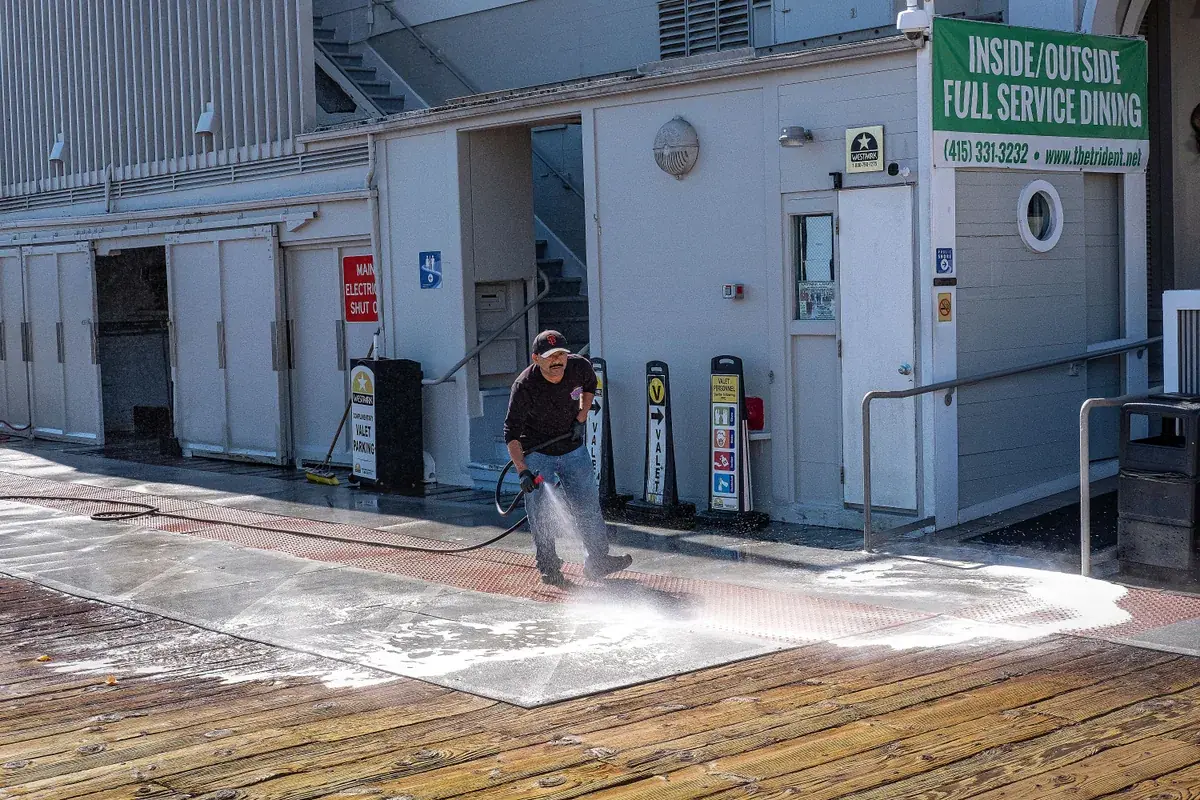
- Day 1 — surface clean at moderate pressure; too much pressure blows out the joint sand and pits the paver face
- Day 1 — treat any weeds, moss and ant colonies in the joints so they cannot regrow under the seal
- Day 1 — treat efflorescence with a dedicated cleaner if the pavers show a chalky bloom
- Dry out — a full 24 to 48 hours of dry weather; we will reschedule rather than seal damp pavers
- Day 2 — sweep in fresh polymeric sand, compact, and activate it with a light mist
- Day 2 — apply two thin coats of breathable sealer rather than one heavy coat, which is what causes pooling and gloss patches
Paver sealing cost in Jacksonville
We price per square foot, and we quote cleaning and sealing as separate lines so you can see exactly what you are paying for.
| Service | Price per sq ft | 500 sq ft patio | 1,000 sq ft driveway |
|---|---|---|---|
| Clean only | $0.25 – $0.40 | $125 – $200 | $250 – $400 |
| Clean + re-sand | $0.55 – $0.85 | $275 – $425 | $550 – $850 |
| Clean + re-sand + seal | $0.95 – $1.75 | $475 – $875 | $950 – $1,750 |
| Strip failed sealer + reseal | $1.75 – $2.75 | $875 – $1,375 | $1,750 – $2,750 |
| Efflorescence treatment | Add $0.15 – $0.25 | Add $75 – $125 | Add $150 – $250 |
Is sealing pavers actually worth it?
Honestly — it depends on the paver and the location, and plenty of Jacksonville patios are better left unsealed.
Sealing is worth it for a driveway that takes vehicle traffic and oil drips, for pavers around a pool where you want the colour to pop, and for anywhere with a weed problem, because locked polymeric sand is what actually stops weeds.
It is less compelling on a shaded back patio that nobody looks at, on very old pavers whose colour has already faded evenly, and on any installation with a drainage problem — sealing a wet base just traps the problem in.
One thing to be clear about: sealing is a maintenance commitment, not a one-off. Florida UV degrades any sealer, and you are re-sealing every two to three years.
What's included in every job
No line items appear on the invoice that weren't on the quote. Everything below is part of the price:
- Full pressure clean of pavers with a surface cleaner
- Weed, moss and ant-hill removal from every joint
- 24–48 hour dry-out before any sealer is applied
- Fresh polymeric joint sand, swept and activated
- Two coats of breathable, non-yellowing sealer
- Efflorescence treatment where the pavers need it
Cleaning only, without sealing, starts at $0.25 per sq ft. Read more in our Jacksonville pricing guide, or see what to ask before hiring anyone.
Expert tips from our crew
Things worth knowing whether or not you hire anyone. Several of these will save you money, and a couple of them will save you from a repair bill.
Ask a sealer what happens if it rains the night before
The right answer is "we reschedule". Anything else means they will seal damp pavers to protect their schedule, and you will be paying to strip and redo it in eighteen months.
Do not seal pavers under a year old
New concrete pavers are still pushing efflorescence — the chalky white bloom — to the surface. Seal over it and it is permanent. Give them six to twelve months first.
The water test tells you if the seal is still working
Sprinkle water on the pavers. Beads means the sealer is intact. Soaks straight in means it has worn through and you are due — usually every two to three years in Florida sun.
Weeds coming back means the joint sand was skipped
Sealer does not kill weeds; polymeric joint sand denies them somewhere to germinate. If weeds returned within a season, the re-sand step was left out of the job.